




30 Aug Find Your Mission Field
We know we need to be sharing our faith. But it is overwhelming. And because we feel this way most of the time, we take no action at all and that is when the guilt can set in.
But why is this the case? After many years of observing Christians and learning how they are prepared to share their faith, I think I have found part of the answer to this question. In my experience, the barrier is simple: most Christians don’t feel equipped. They don’t know how to do it. I’m convinced that it’s really a training issue. The fact of the matter is most Christians have never really been trained on how to start a spiritual conversation, or explain the gospel.
Macy, my daughter, is the leader of her dance squad at school. Once a year during halftime, the dads of the girls on the squad join them for a dance in front of the whole school. It’s intimidating. The first year I was petrified. This is a coordinated dance mind you…the type you have to practice for…a lot. I was trembling with fear. But after I learned the moves, my anxiety dissipated and gave way to uh, well maybe not a joy, because I don’t think its my thing to dance in front of bleachers of high school football fans, but I could manage. And ok, it was fun.
Sharing our faith is the same. We are nervous and overwhelmed when we don’t know how to engage our family, friends and co-workers. We need practical steps.
And in our frustration we offload the responsibility to others in vocational Christian work. But we each have a mission field that is right in front of us. Rather than offload that responsibility, we need tools and training to go from being stuck to empowered and making a difference in the lives of others.
Missions Isn’t Just Something That Happens Overseas
Ask Christians where “the mission field” is, and they’ll picture a map of Asia, the 10/40 Window, an unreached people group whose name they can’t quite pronounce. All of that is real and true, and it matters enormously. Storyline’s own work training over 3,500 leaders a year across dozens of countries is focused on mobilizing missionaries to the unreached.
But that picture, by itself, may run a danger in conveying an incomplete picture about the totality of the scope of the mission field before the church: that mission is defined merely in geographic terms. If missions only happens overseas, then anyone who isn’t overseas is, by definition, playing junior varsity league, or maybe off the hook entirely in regard to embracing the mission Jesus gave us.
Let’s examine how Jesus frames up the mission. His method of disciple making is instructive. When He sent His disciples out, He didn’t only send them across borders — He sent them into their own towns, their own synagogues, their own family systems. His life and ministry gave us the model.
The Biblical Concept Behind SENT: Oikos
 The word behind this whole study is a Greek term used throughout the New Testament: oikos. Pronounced “oy-kos.” It’s usually translated “household,” in the greek, but its real meaning is broader — your oikos is the whole web of people who already know you: family, coworkers, neighbors, the same barista who makes your coffee every morning. This is your sphere of influence – a network unique to you and your life.
Look at how conversion actually spreads in the book of Acts. When the Philippian jailer came to faith, Scripture says he was baptized “he and all his family” that same night — his entire household. When Cornelius sent for Peter, he’d already gathered his relatives and close friends to listen. The pattern isn’t isolated individuals converting in a vacuum. It’s household by household, relationship by relationship.
Most people, sociologists and missiologists both estimate, maintain somewhere between 8 and 15 relationships close enough to carry real influence — the people who’d actually notice if you disappeared. That’s not a hypothetical mission field. That’s a real, specific, already-existing network that you’re already standing in the middle of.
Notice what this isn’t. It isn’t walking up to strangers at the mall and asking if they go to church. It isn’t a scripted approach on someone who never invited the conversation. Most people, believers included, can feel the difference between someone building a relationship and someone performing one — and the performing kind is exactly what turns people away. Oikos starts with people who already trust you. You don’t have to earn the right to speak into fifteen lives by tomorrow. You just have to start seeing the ones you already have.
Map Your Own Oikos — Free
Before you go further, take five minutes and write down your own list. The free Oikos Mapping Tool walks you through all six spheres of your life — family, work, neighbors, and beyond — so you can see your mission field on paper instead of just in theory.
Get the Free Oikos Mapping Tool → |
Prefer working through this one small step a day? The Storyline Sent 30-Day Challenge app walks you through the same oikos process, at a pace that doesn’t require you to have it all figured out today.
Why “You Have a Mission Field” Isn’t Enough on Its Own
Here’s where a lot of good teaching on this topic stalls out. In the Christian community there is plenty of messaging that will tell you that you have a sphere of influence and that you need to be a witness. Very few tell you what to actually do. People need to be trained. And the best training environments are “live-fire” situations. This should be a universal maxim about training whenever the stakes are high. And the stakes couldn’t be any higher in regard to where people spend eternity, so doesn’t it makes sense that we take training seriously?
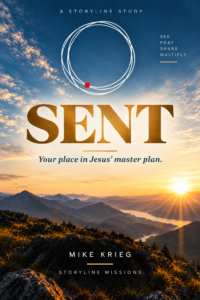
The following are some ideas from our book called Sent. It is a resource meant to help Christians more fully embrace what it means to be an ambassador of Christ.
What’s Actually Inside SENT
SENT is a five-chapter study, usable either individually or in a small group, structured around five movements:
1. You Are Sent — Grounded in John 20:21 (“As the Father has sent me, I am sending you”), this chapter makes the case that sending isn’t a special calling for missionaries — it’s the basic shape of what it means to follow Jesus at all.
2. There Is a Mission Field Unique to You — This is where oikos gets personal. Readers map out their own 8–15 people, using the same relational logic seen throughout Acts.
3. You Have People — Moving from an abstract list to real names, honestly assessing where each person actually stands spiritually — resistant, curious, already a believer, or simply never asked.
4. You Have a Mission — The most practical chapter in the study, and the one built directly for anyone who’s ever frozen up mid-conversation or not known what to say next. Rather than assuming people already know how to have a spiritual conversation, this chapter teaches three specific, learnable skills: telling your own story in under three minutes, a five-word gospel framework (God, Sin, Jesus Christ, Trust, Relationship) with memory verses for each word, and how to discern someone’s actual next step rather than pushing for an instant decision.
5. You Can Reproduce Yourself — The study closes by asking readers to do for someone else what this study just did for them, built around a simple, repeatable discipleship pattern: Meet, Word, Obey, Pray, Mission, Repeat.
Every chapter ends with discussion questions written to work either for individual reflection or small group conversation, plus concrete action points — not just “think about this,” but a specific, doable step before the next chapter.
Skip Ahead — Start Practicing Today, Free
The Oikos map and the five-word gospel aren’t just something you read. They’re built into a free 30-day companion app you can start using in the next five minutes.
Storyline Sent walks you through one small, doable step a day — see your oikos, pray for your Five, and practice sharing your faith. Available in English, Russian, Ukrainian, Spanish, and Indonesian.
Begin the 30-Day Challenge → |
No download, no app store — it works right in your browser, and it’s fre
Real Stories Behind the Oikos Concept
SENT doesn’t just teach the oikos concept in theory — it’s built around real testimonies of what happens when ordinary believers actually apply it.
At one church, a young believer named Josh struck up an unplanned friendship with a man named Rocco at a coffee shop. That friendship eventually led to Rocco trusting Christ — and when he was baptized, he specifically wanted Josh there, because Josh had walked the road with him. That single relationship wasn’t an outlier at that church; in one baptism service, all fourteen people being baptized had come to faith through exactly this kind of relational pathway.
Another story follows a man named Ryan, who came to faith reluctantly after his wife started attending a Bible study. Within a short time of his own conversion, Ryan was already sharing what had changed in his life with a customer at his coffee shop — who then brought his own brother-in-law to a men’s event at the church. Ryan didn’t need years of theological training to become part of someone else’s journey to Christ. He needed a true story and a coffee shop full of regular customers.
These aren’t hypothetical case studies. They’re the kind of ordinary, unforced moments SENT is trying to help readers recognize and act on in their own lives.
Who SENT Is Built For
SENT works for:
- Individuals wanting a structured way to actually apply the Great Commission to their own relationships, not just agree with it in principle
- Small groups looking for a five-week study with built-in discussion questions and group-friendly action points
- Churches wanting a simple, reproducible framework to teach alongside — or instead of — a traditional evangelism program that tends to fade after the initial launch enthusiasm
If your church has ever run an evangelism emphasis that generated energy for a few weeks and then quietly disappeared, SENT is built to solve exactly that problem — not with more information, but with a framework simple enough to actually become part of how your congregation thinks.
How to Get Started With SENT
SENT is available now as a digital download through the Storyline store. It includes the full five-chapter study, ready to work through on your own or lead a group through over five sessions.
If you’ve already gone through Storyline’s other resources — the Storyline Study or the Storyline Seminar — SENT isn’t a replacement for either one. Think of it as the next layer down: where those resources build a broad biblical, historical, and strategic vision for world missions, SENT zooms all the way in to the relationships already sitting in your own life.
You don’t need a seminary degree, a plane ticket, or a bold personality to start. You need to see what’s already true: God placed you exactly where you are, surrounded by exactly the people you’re surrounded by, on purpose.
— Mike
Find Your Mission Field
SENT walks you through five simple movements to discover and reach the mission field already around you — built for individual study or small groups.
$3.99 for the book digital download, including discussion questions and action points for every chapter.
Get SENT Today → |
Also available: the Storyline Study, the Storyline Seminar, and the Storyline Podcast — see all resources at storylinemissions.org.
