




30 Oct How South Korea Became the World’s 2nd Largest Missionary Sending Nation: A Model for Emerging Movements
How South Korea Became the World’s 2nd Largest Missionary Sending Nation: A Model for Global Movements
As the global Christian church outside of the West continues growing, there is a desire by church leaders in Africa, Latin America, Southeast Asia, and Eastern Europe to develop emerging systems of missionary sending. They want to be faithful to Jesus’ invitation to the Christian church to be ‘senders’ and not merely ‘receivers’ of the Great Commission.
Jesus tells every Christian, and church leader, in Matthew 28:19 that we are to “Go, and make disciples of all nations” (people groups). When a Costa Rican man or a Ukrainian woman reads their Bible and discovers that Jesus is inviting them to participate in His mission, they are increasingly ready to respond.
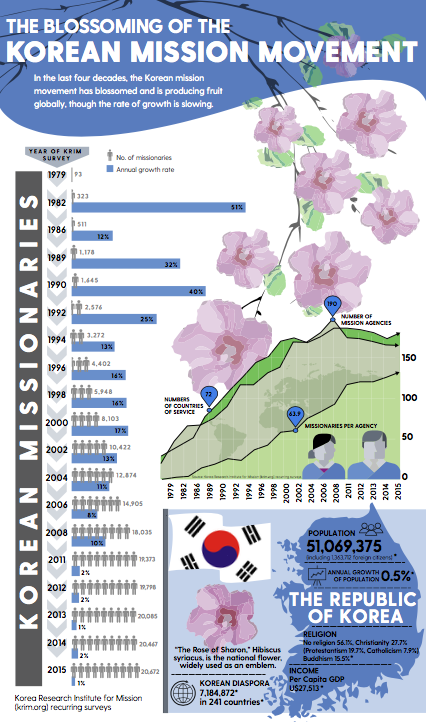
One compelling example of how missionary sending from the global church, outside of the West, has been effectively activated in recent years is the country of South Korea. Over just 40 years, the Christian church in South Korea transformed from sending virtually no missionaries into a global powerhouse—now the 2nd largest missionary-sending nation in the world after the United States.
 The Remarkable Growth: From 93 Missionaries to 20,000+
The numbers tell a striking story. In 1979, South Korea sent just 93 missionaries to foreign locations. Ten years later, by 1989, that number had risen to 1,178. By 1998, it reached 5,948. And by 2015, South Korea had sent over 20,000 missionaries around the world.
To put this in perspective, in 2013 South Korea ranked #5 globally at 1,014 missionaries sent per million church members—significantly outpacing the United States, which ranked #9 at 614 missionaries per million church members. This is remarkable considering Christianity only arrived in Korea about 200 years ago.
According to the Korea World Missions Association, an umbrella organization for Korea’s Protestant missionaries, more than 23,000 Korean missionaries have been sent abroad as of January 2012, making Korea the world’s 2nd largest exporter of missionaries.
Why Is Christianity So Strong in Korea?
To understand Korea’s missionary movement, we must first understand why Christianity took root so powerfully in this nation. Currently, nearly 28 percent of Koreans are Christians—approximately 8 percent Catholic and 20 percent Protestant. (For reference: 56 percent of Koreans have no religion, and Buddhism is the second largest faith at nearly 16 percent.)
But the statistics alone don’t explain Korea’s missionary passion. The deeper reason lies in Korea’s spiritual history.
 A Church Born Through Missionary Service
Christianity arrived in Korea two centuries ago. Catholicism came first in the early 1800s, and the first Korean priest, St. Andrew Kim Taegon (the patron saint of Korea), was ordained in 1845. Protestantism arrived later but spread rapidly, especially after the Pyongyang Revival of 1907—an event so transformative that Christians began calling Pyongyang the “Jerusalem of the East.”
Here’s the crucial point: Nearly all major congregations in Korea can trace their origin to a missionary who arrived in the early 19th century. Additionally, after the Korean War, a constant stream of American missionaries came to provide humanitarian aid and help develop Korean churches.
This created something powerful in the Korean Christian consciousness: a deep awareness that their own faith came through missionaries. That memory shapes their commitment to sending missionaries today.
The Strategic Factors Behind Korea’s Missionary Movement
The Korean missionary sending movement didn’t happen by accident. Several strategic factors converged to create this powerful global witness:
Factor #1: A Unique Prayer Culture
Korean churches maintain a tradition of early morning prayer, with many believers gathering at 5 a.m. before work to worship and pray. It’s through these dawn prayers that many Koreans have felt called to missionary service—and many answer that call immediately.
Korean Christians are characterized by a passionate faith. When God leads, they are willing to go even if it seems risky, trusting that God will provide. As one missionary described it, they follow the example of Abraham, who went out without knowing where he was going.
Factor #2: Church Pride in Missionary Sending
In Korea, there’s a cultural proverb: “A tiger dies and leaves his coat. A man dies and leaves his name.” This mentality applies to local churches as well. Many Korean congregations believe that a healthy, strong church must send its own missionaries to leave a “missions mark on the world.”
This has created a culture where churches take pride in their missionary sending. Churches that have sent missionaries celebrate that legacy, while those that haven’t sometimes feel they haven’t fully fulfilled their calling. Moreover, there are strong relational ties between sending churches and their missionaries—the church remains actively responsible for the missionary’s needs.
Factor #3: “Silver Missionaries” — Mobilizing Retirees
Korea’s baby boomer generation (born 1955-1963) makes up nearly 15 percent of Korea’s population. Every year, about 1 million Koreans retire. Many of these faithful Christians want to live a “second life” after retirement by serving as missionaries. This has created a steady stream of experienced, committed missionaries entering the field.
Factor #4: Government Policy and Opportunity
After successfully hosting the 1988 Seoul Olympics, the Korean government allowed its citizens to travel overseas freely. As long as someone had a clean criminal record, they could get a passport and travel abroad at will. This became a landmark turning point for the Korean missionary movement.
Coinciding with this new freedom, God opened two major mission fields: Central Asia (especially Mongolia and China) and the Middle East. Korean missionaries were positioned to enter at exactly the right moment, and they responded en masse.
Click to Download the file
What Other Nations Can Learn From Korea’s Model
Korea’s missionary movement offers crucial lessons for emerging sending movements in Africa, Latin America, Southeast Asia, and Eastern Europe:
1. Mobilization requires theological conviction, not just statistics. Korea’s sending movement is built on the biblical foundation that every Christian is called to participate in God’s mission. That conviction, not guilt or manipulation, mobilizes churches.
2. Prayer precedes action. Korea’s early morning prayer tradition is foundational. Before Korea could send missionaries, Korean Christians had to pray. Prayer shaped their identity and kept them focused on God’s mission.
3. The sending church must remain relationally connected. Korean churches don’t simply send missionaries and forget them. There’s ongoing support, accountability, and relationship. This strengthens both the missionary and the sending church.
4. Legacy matters. When churches understand that their own faith came through missionaries, they are motivated to pass that gift forward. This is why helping emerging movements understand their own missionary heritage is so important.
5. Every season has a role to play. From young career missionaries to “silver missionaries” in their retirement years, the Korean model mobilizes believers across all life stages. This ensures a constant pipeline of committed workers.
What This Means for Western Churches
As North American Christians begin to understand the potential for missionary sending from the global church, we must ask ourselves difficult questions:
- Is there something we can contribute to these emerging movements?
- Has Christian missions moved on from the Western Church?
- Could we be a hindrance to the future of global missions?
The reality is that God is growing His church around the world, and new movements are developing to partner with Him in fulfilling the Great Commission. The Korean example shows us that the future of missions is not “from the West to the world,” but rather “from everywhere to everyone.”
This is a humbling but hopeful reality. It means every believer, in every nation, has a role to play in God’s global mission.
Discovering Your Role in the Global Mission
Perhaps you read about Korea’s missionary movement and felt challenged. You know Jesus called every Christian to participate in His mission, but you’re not sure what that looks like for you specifically.
Not everyone is called to move overseas. But like the Koreans understood, everyone is called to join God’s mission. The question is: What is your specific role?
Are you called to Go? To Send? To Pray? To Mobilize? To Welcome? South Korea mobilized believers by helping them discover their unique calling—and that same clarity can transform your life and your church.
If you want to explore this more deeply, the Storyline Study is designed to help you and your church discover exactly how God designed you for His global mission. Over 8 weeks, you’ll move from “I know I should care about missions” to “Here’s exactly what God created me to do.”
 For More Resources on Global Missions
- Bible Verses for New Year 2026 Reflections
- 7 Bible Verses About Mission and Outreach
- 7 Mission Trip Bible Verses for Churches and Teams